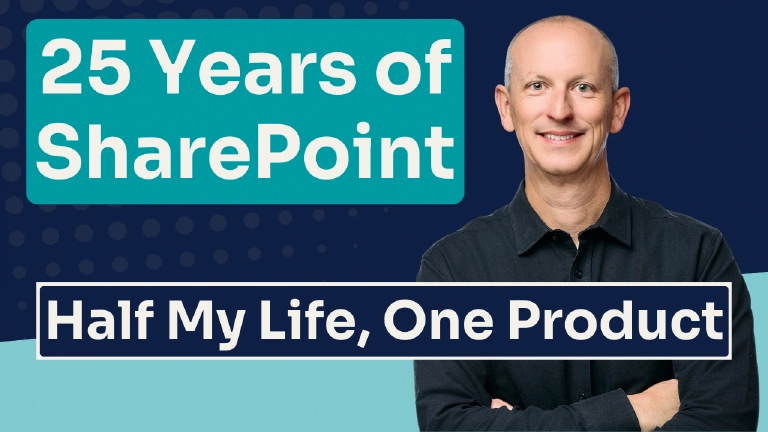
Two days before Microsoft celebrated SharePoint’s 25th birthday, I celebrated my 50th birthday… and the math on that isn’t lost on me.
I’ve spent roughly half my life working with one product. Nearly my entire professional career built on a single platform.
That’s either crazy dedication, Stockholm Syndrome, or a cautionary tale, depending on who (and when) you ask.
SharePoint launched in 2001 as an undocumented portal server with no public API. Over 25 years, it evolved through major inflection points: SharePoint Portal Server 2003 kicked off enterprise intranet adoption, Office SharePoint Server 2007 introduced the first real developer extensibility model with Features and Solutions, and the SharePoint Framework (SPFx) eventually moved custom development to a modern client-side architecture. Along the way, it spawned an entire ecosystem of developer careers, businesses, and one of the most enduring communities in enterprise software. This is what that journey looked like from my point of view.
How SharePoint developer careers began in 2003
I didn’t choose SharePoint, I was pushed into it. Or more accurately, my employer in 2003 chose it, and I got pulled along for the ride.
It was September 2003. I was working for Fidelity Information Services, the company that built the software running behind banks like Bank of America and Washington Mutual. We’re talking ATMs, back-end processing, the kind of infrastructure you never think about until it breaks. I worked in the group that built internal tools for the organization: the corporate intranet, the public website, that sort of thing.
SharePoint Portal Server 2003
The company had just selected SharePoint Portal Server (SPS) 2003 as the platform for their new corporate intranet, and they hired me as a .NET developer to help transition their team of Notes developers over to the Microsoft stack. That was my entry point. Not exactly a glamorous origin story, but that’s how most careers in enterprise software actually start: someone makes a platform decision and you’re the person in the room who gets tapped to make it work.
Microsoft Content Management Server 2002
Around the same time, we had a need for web content publishing, so we ended up combining SPS 2003 with Microsoft Content Management Server (MCMS) 2002. Here’s the fun part: Microsoft themselves had a skunkworks project called “Project Jupiter” that was trying to do the exact same thing, merging SharePoint Portal Server, Content Management Server, and Commerce Server into one product. They eventually abandoned it. Meanwhile, we were over here doing it ourselves in production. As part of our enterprise agreement with Microsoft, we had access to a Microsoft Consulting Services (MCS) consultant who came in, looked at what we’d built, and basically said, “Huh. You guys actually pulled this off.”
That was 2003. I’ve been in the SharePoint world ever since.
What early SharePoint development was like before public APIs
There’s no polite way to say this: early SharePoint development was a hack job. There were no docs. There was no public API. I spent my time using .NET Reflector to reverse-engineer the SharePoint.dll, trying to figure out how the internals worked so I could extend the platform in ways Microsoft never intended.
That kind of work, digging into the guts of an undocumented platform and figuring it out through sheer stubbornness, ended up being valuable. I started sharing what I learned in the SharePoint and MCMS newsgroups, answering questions, helping other developers who were banging their heads against the same walls. That community involvement, along with co-authoring my first book, led to Microsoft recognizing my contributions with an MVP award in 2005.
Why fully trusted SharePoint code became a long-term problem
Microsoft Office SharePoint Server 2007
When Office SharePoint Server 2007 shipped, everything changed. Microsoft added a proper plugin and deployment framework with Features and Solutions. That was a massive deal. It meant developers could build and deploy custom solutions in a structured, supported way. Adoption exploded, and so did the ecosystem of custom solutions built on top of SharePoint.
I bought into it completely. I was showing people how to build full custom applications on top of SharePoint. And for a while, that worked.
Those solutions ran as fully trusted code, which created tight dependencies on the SharePoint infrastructure. Every time Microsoft released a new version of SharePoint, upgrading became a nightmare because all that custom code was deeply coupled to the platform internals. It was a hard lesson, but an important one: just because you can build something on a platform doesn’t mean you should, at least not without thinking carefully about the long-term implications.
That experience shaped how I approach platform development to this day. I’m a lot more thoughtful now about where the boundaries should be between your code and the platform you’re building on.
What 25 years really gives you
Over the years, I got to work more and more closely with Microsoft. I learned how enterprise software gets made at scale, which is an education you can’t get from any article, book, or course - it’s 100% a lived experience. And I made some incredible connections along the way.
But if I’m being honest about what this journey has meant to me, the technical stuff isn’t what stands out most. It’s the people.
This product, and the community around it, has given me some of my closest friends in the world. Not just around the country, but around the world. I’ve known many of these people for over 20 years now. We’ve watched each other grow up, start families, lose hair, change companies, and somehow keep showing up in the same community. We’ve lost friends along the way too, which is the part nobody warns you about when you stick around long enough, but that’s part of life.
I know it might sound a little sad to say that some of your closest friends are people you met through work. But I don’t see it that way. Going to a conference and knowing that people you genuinely care about will be there, people you’ve known for two decades, that’s something special. It’s not just professional networking at that point. It’s real friendship, forged over years of shared experience.
The other thing this community gave me was perspective. For the first half of my life, my worldview was pretty America-centric. I didn’t travel much, either within the United States or abroad. When I started getting opportunities to speak at events in Europe and work with people from very different backgrounds and cultures, it changed me. Not in some dramatic way, but in the quiet way that happens when you spend real time with people who see the world differently than you do. I’ve become a more well-rounded person because of it. This community is how that happened for me, and I’m grateful for it.
Two businesses, one platform
This path led me to start two businesses. In 2009, I co-founded Critical Path Training, focused on SharePoint developer training. Then in 2016, I founded Voitanos and launched my first self-hosted courses. Voitanos is still going strong today, and it’s the vehicle through which I do all my training, courses, workshops, content creation, and coaching.
Both of those businesses exist because of SharePoint. Or more precisely, because of the skills and relationships I built while working in the SharePoint ecosystem over all those years.
Happy birthday, SharePoint
Here’s the thing: I’m not spending as much of my time on SharePoint these days as I used to. The platform has evolved, and so has my focus. These days my time is split between SharePoint Framework (SPFx) development, building apps for Microsoft Teams, and the developer story for Microsoft 365 Copilot declarative agents. That split is going to keep shifting as the platform continues to evolve.
But SharePoint is where it all started. Twenty-five years of a product that, for all its quirks and frustrations (and trust me, there have been plenty), has been the foundation of my entire career. It gave me a livelihood, two businesses, friendships that span decades and continents, and a perspective on the world I wouldn’t have gotten any other way.
So happy birthday, SharePoint. Here’s to whatever comes next.

Microsoft MVP, Full-Stack Developer & Chief Course Artisan - Voitanos LLC.
Andrew Connell is a full stack developer who focuses on Microsoft Azure & Microsoft 365. He’s a 22-year recipient of Microsoft’s MVP award and has helped thousands of developers through the various courses he’s authored & taught. Whether it’s an introduction to the entire ecosystem, or a deep dive into a specific software, his resources, tools, and support help web developers become experts in the Microsoft 365 ecosystem, so they can become irreplaceable in their organization.